 Skip to content

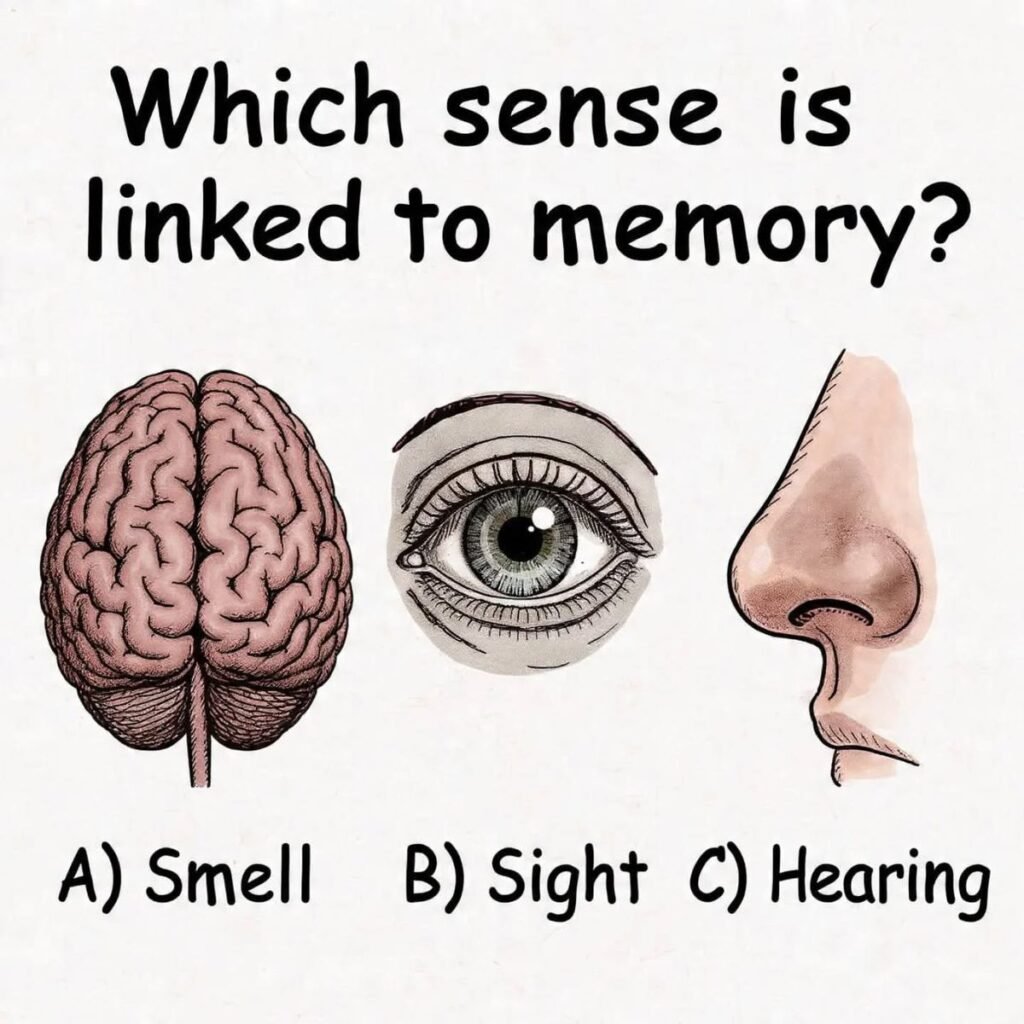

Which Sense Is Most Closely Linked to Memory? Neuroscience Solved
Science trivia and brain function riddles are continuous engagement drivers across social media. They spark curious discussions in comment sections because people often reflect on their own sensory experiences—like how a whiff of fresh cookies or old perfume instantly brings back childhood memories.
A popular educational quiz graphic asks a direct question above illustrations of a brain, an eye, and a nose:
“Which sense is linked to memory?”
A) Smell
B) Sight
C) Hearing
While all human senses interface with memory systems, olfactory perception (smell) holds a unique anatomical connection to emotional memory processing in the brain.
In this guide, we break down the neuroscience behind sensory memory, explain the Proustian phenomenon, and reveal the definitive answer.
The Neuroscience: Why Smell Is Uniquely Wired to Memory
To understand why Smell (Option A) has the strongest and most vivid link to memory, we look at how sensory signals travel through the human brain:
                  [ SENSORY INPUT PROCESSING PATHS ]
                                   |
      -----------------------------------------------------------
     |                                                           |
 [ VISION & HEARING ]                                      [ SMELL (OLFACTION) ]
 • Retina / Ear receptors                                  • Olfactory bulb receptors
 • Sent to the Thalamus (relay station)                    • BYPASSES the Thalamus!
 • Forwarded to sensory cortices                           • Connects DIRECTLY to:
 • Indirect connection to memory centers                   1. Amygdala (Emotional Processing)
                                                           2. Hippocampus (Memory Formation)
1. Direct Anatomical Pathways
For most senses—such as Sight and Hearing—incoming signals must first pass through the thalamus, a central neural relay station, before being routed to areas responsible for conscious thought and long-term memory storage.
In contrast, olfactory signals travel directly from the nasal cavity into the olfactory bulb. From there, neural pathways route directly into two key limbic system structures:
-
The Amygdala: The center for emotional processing.
-
The Hippocampus: The critical region for memory encoding and retrieval.
2. The Proust Phenomenon
This direct neuroanatomical connection explains why scent-triggered memories (known as Proustian memories, named after novelist Marcel Proust) are often far more vivid, emotional, and immediate than visual or auditory cues.
Scientific Comparison Table
| Sense | Primary Organ | Brain Routing | Connection to Emotion & Memory |
| Smell (Olfaction) | Nose | Direct to Amygdala & Hippocampus (Bypasses Thalamus) | Extremely Strong & Immediate |
| Sight (Vision) | Eye / Retina | Passes through Thalamus to Visual Cortex | High volume detail, moderate emotional charge |
| Hearing (Audition) | Ear / Cochlea | Passes through Thalamus to Auditory Cortex | Strong for music/voices, routed through relay |
The Answer
The primary answer to “Which sense is linked to memory?” is A) Smell.
Frequently Asked Questions (FAQ)
Which sense has the strongest connection to memory?
Smell (olfaction) has the most direct neuroanatomical link to the brain’s emotional and memory centers (the amygdala and hippocampus).
Why do smells trigger memories so fast?
Because olfactory nerve signals bypass the thalamus—the brain’s main sensory relay hub—and go straight to the limbic system, triggering emotional nostalgia in milliseconds.