 Skip to content


How Many Cubes Are In This Figure? The 3D Block Stack Puzzle Solved
Spatial reasoning tests and 3D visual perception riddles are hugely popular on social media. They challenge viewers to think beyond what is directly visible on the surface by accounting for hidden structural support blocks underneath elevated layers.
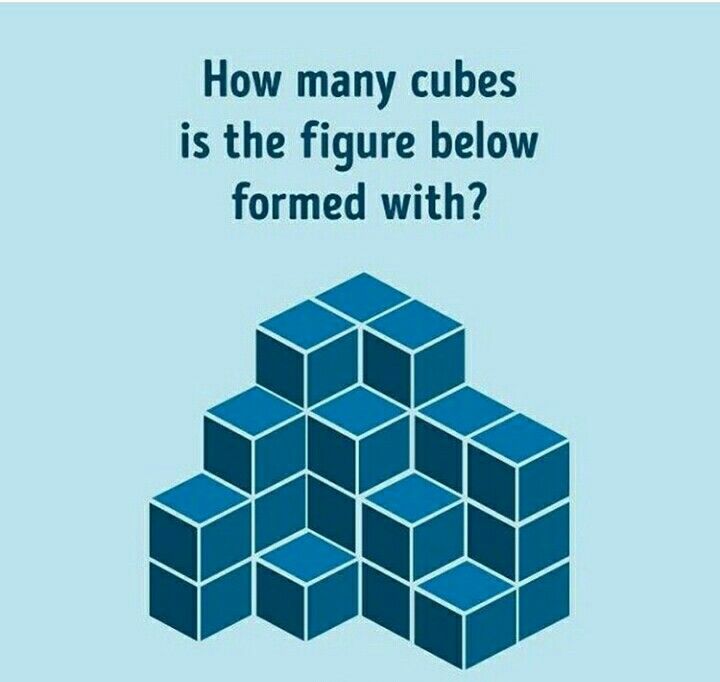
A classic block-counting puzzle asks a direct question above a blue isometric cube structure:
“How many cubes is the figure below formed with?”
While it is tempting to simply point and count the visible faces, solving this puzzle accurately requires breaking down the structure either layer-by-layer from top to bottom or column-by-column by height.
In this guide, we break down the geometry of the cube stack, analyze both counting methods, and reveal the exact solution.
Deconstructing the Structure: Layer-by-Layer Breakdown
Because gravity requires higher cubes to rest on top of lower cubes, every elevated block implies a hidden stack beneath it. Analyzing the structure by horizontal layers (from top to bottom) guarantees that no hidden cubes are missed:
                    [ 3D CUBE STACK LAYERS ]
                               |
      -------------------------------------------------------------
     |                  |                 |                        |
 [ LAYER 4 (TOP) ]  [ LAYER 3 ]       [ LAYER 2 ]          [ LAYER 1 (BASE) ]
 • 2 Peak Cubes     • 2 (Under Top)   • 5 (Under Layer 3)  • 8 (Under Layer 2)
                    • + 3 New Cubes   • + 3 New Cubes      • + 2 Front Cubes
 • Count = 2        • Count = 5       • Count = 8          • Count = 10
1. Layer 4 (Top Level)
-
Description: The two highest peak cubes at the top back of the structure.
-
Layer Count: $\mathbf{2}$ cubes.
2. Layer 3 (Second Level Down)
-
Description: Includes 2 hidden support cubes directly beneath the top peaks, plus 3 new visible cubes at this height.
-
Calculation: $2 + 3 = \mathbf{5}$ cubes.
3. Layer 2 (Third Level Down)
-
Description: Includes 5 hidden support cubes beneath Layer 3, plus 3 new visible cubes added at this height (far-left, far-right, and mid-back).
-
Calculation: $5 + 3 = \mathbf{8}$ cubes.
4. Layer 1 (Bottom Base Level)
-
Description: Includes 8 hidden base cubes supporting all higher columns, plus 2 front-center low cubes touching the ground.
-
Calculation: $8 + 2 = \mathbf{10}$ cubes.
Column-Height Summary Table
Alternatively, we can count the total number of vertical columns by identifying every visible top face (diamond) and summing their respective heights:
| Column Position | Number of Columns | Height per Column | Total Cubes |
| Top Peak Columns | 2 | 4 cubes high | $2 \times 4 = 8$ |
| Mid-Height Columns | 3 | 3 cubes high | $3 \times 3 = 9$ |
| Lower-Mid Columns | 3 | 2 cubes high | $3 \times 2 = 6$ |
| Front Base Columns | 2 | 1 cube high | $2 \times 1 = 2$ |
| TOTALS | 10 Columns | — | 25 Cubes |
The Answer
The total number of cubes forming the figure is 25.
Common Mistakes & Why People Miscalculate
-
Only Counting Visible Exterior Cubes: Viewers frequently count only the cubes with faces they can clearly see from the front angle (often landing on 15 to 18), ignoring the inner structural blocks.
-
Missing the Back/Corner Columns: Stacks located in the background or along the outer wings (such as the height-3 column behind the far left) are easily overlooked if not systematically mapped.
Conclusion
The complete answer to “How many cubes is the figure below formed with?” is 25. By breaking down the 10 individual vertical columns or summing the 4 horizontal layers ($2 + 5 + 8 + 10$), we arrive at the exact spatial total!
Frequently Asked Questions (FAQ)
What is the easiest way to solve 3D cube stack puzzles?
The most reliable method is to count the top-facing diamond surfaces to find the total number of columns, identify each column’s height, and add them together.
How many total columns are in this figure?
There are 10 distinct vertical columns standing on the base level.