 Skip to content

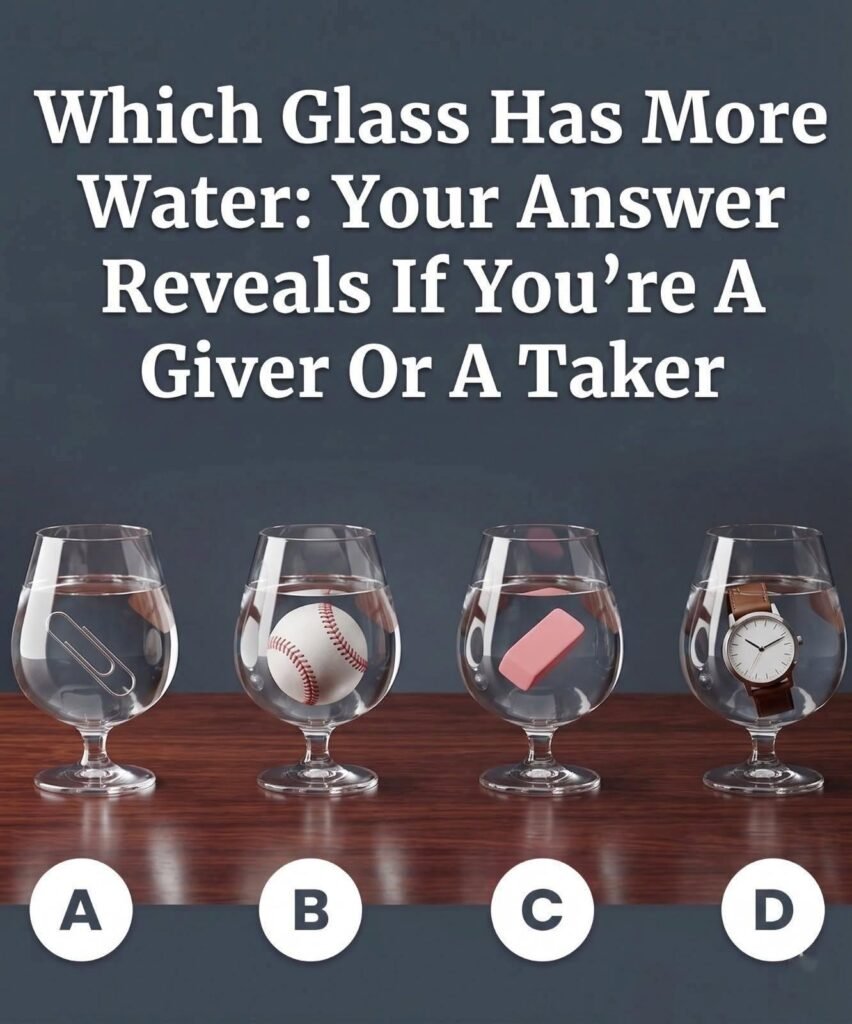

Visual puzzles that blend physics, volume displacement, and personality traits have become a sensation across social media platforms. One of the most popular variations features four identical glasses filled with water up to the exact same visual line, each containing a different everyday object: a paperclip (Glass A), a baseball (Glass B), a pink rubber eraser (Glass C), and a wristwatch (Glass D). The graphic presents a intriguing double challenge: figure out the science of which glass contains the most actual water, and discover what your answer supposedly reveals about your personality—specifically whether you are a “giver” or a “taker.“
While the personality claim is a fun, social media trope designed to ignite discussion, the underlying physical puzzle is grounded in fundamental scientific principles. Archimedes’ principle of fluid displacement dictates the true answer. Let’s break down the physical logic, examine why the visual levels trick the eye, and explore the fascinating science of volume and perception.
The Physics Solution: Archimedes’ Principle and Volume Displacement
To solve the puzzle scientifically, you must understand how submerged objects affect the height of liquid in a container.
+------------------------------------------------------------------------+
|                      FLUID DISPLACEMENT FORMULA                        |
|                                                                        |
|   Total Height Level = Actual Water Volume + Volume of Submerged Object|
|                                                                        |
|   Therefore:                                                           |
|   Actual Water Volume = Total Height Level - Volume of Submerged Object|
+------------------------------------------------------------------------+
The Concept of Liquid Displacement
When an object is placed into a glass filled with liquid, it displaces a volume of water equal to the volume of the object itself (or the submerged portion of the object).
Because all four glasses in the image show the water level reaching the exact same line, the total visual volume inside each glass is identical. To find which glass contains the highest amount of actual water, you must subtract the volume occupied by the object inside it:
To maximize the remaining water volume, you must choose the glass containing the smallest object by physical volume.
Object-by-Object Breakdown
Let’s evaluate the physical volume of each object placed inside the four glasses:
+------------------------------------------------------------------------+
|                       OBJECT VOLUME COMPARISON                         |
|                                                                        |
|   Glass A: Paperclip  -> Extremely Small Volume  (Most Water Remaining)|
|   Glass B: Baseball   -> Very Large Volume       (Least Water)         |
|   Glass C: Eraser     -> Moderate Volume         (Medium Water)        |
|   Glass D: Watch      -> Medium-Large Volume     (Less Water)          |
+------------------------------------------------------------------------+
Glass A: The Paperclip
A paperclip is made of thin wire with minimal overall volume. It takes up virtually zero space inside the glass. Because it displaces almost no liquid, almost the entire volume up to the water line consists of real water.
Glass B: The Baseball
A standard baseball is a large, solid sphere. It occupies a massive portion of the space inside the glass. To reach the same fill line as the other glasses, very little actual water was required because the ball takes up most of the room.
Glass C: The Pink Eraser
A rubber eraser is a solid block of moderate density and size. While smaller than a baseball, its volume is significantly greater than that of a thin wire paperclip.
Glass D: The Wristwatch
A wristwatch consists of a thick metal or plastic casing, glass face, and leather strap. It displaces a substantial amount of water—far more than a paperclip or eraser, though usually less than a full baseball.
The Definitive Scientific Answer
Glass A (the paperclip) contains the most water. Because the paperclip occupies the smallest physical volume among all four objects, Glass A requires the highest amount of actual liquid to reach the fill line.
Personality Psychology: Givers, Takers, and Visual Choices
While the physics behind fluid displacement is exact, why do online riddles pair logical puzzles with personality categories like “Giver” vs. “Taker”?
The “Giver vs. Taker” Social Metaphor
In popular psychology literature—most notably popularized by organizational psychologist Adam Grant—people are often categorized by how they interact with others:
-
Givers: Individuals who naturally focus on helping others, sharing resources, and adding value without expecting immediate returns.
-
Takers: Individuals who focus on acquiring resources, protecting personal advantage, and securing maximum value for themselves.
-
Matchers: Individuals who strive for equal exchange and balance in transactions.
In the context of this viral image, the connection to personality is a playful metaphor based on how your mind approaches problem-solving:
-
The Analytical Giver (Choosing Glass A): People who look closely at hidden details recognize that the paperclip leaves the most room for pure water. They value substance over appearance and focus on maximizing genuine value for others.
-
The Intuitive Mind (Choosing Glass B or D): People who pick larger objects often focus on prominence, visual weight, or personal utility (like a watch or sports equipment), reflecting an immediate, outward-focused perceptual style.
While choosing a glass on social media does not scientifically diagnose your psychological profile, it highlights how individuals balance immediate visual intuition with step-by-step logic.
Cognitive Benefits of Visual Logic Exercises
Regularly challenging your mind with visual physics riddles, logic tests, and spatial puzzles offers proven benefits for cognitive health and mental performance across all ages.
1. Strengthening Critical Observation
Puzzles with trick conditions force your visual cortex to slow down. Instead of accepting the surface appearance—that all glasses have “equal” water because the lines match—your mind learns to account for hidden structural variables like object volume.
2. Encouraging Problem-Solving Agility
Analyzing physical mechanics in everyday items builds problem-solving skills, exercising the prefrontal cortex responsible for reasoning, planning, and quantitative evaluation.
3. Promoting Neuroplasticity and Focus
Consistently testing your brain with new logic problems stimulates neural pathway connectivity, helping maintain focus, mental speed, and working memory throughout life.
Real-World Applications: Analytical Thinking in Life and Finance
The ability to look beyond initial appearances and measure real substance is a vital skill that extends far beyond casual internet riddles. Analytical thinking plays a pivotal role in education, career advancement, personal business management, and long-term financial security.
Navigating Complex Financial and Legal Decisions
Just as you must subtract the object’s volume to see the real water level in the puzzle, making sound financial choices requires evaluating underlying facts rather than surface marketing:
-
Loans and Mortgages: When applying for a mortgage or personal loan, looking beyond low headline interest rates reveals hidden fees, closing costs, or variable terms.
-
Legal and Business Services: Consulting with a qualified attorney or legal services provider ensures contracts protect your true assets rather than relying on verbal agreements.
-
Investment and Retirement Planning: Evaluating long-term investments, stocks, or retirement plans requires analyzing net returns after fees, inflation, and market risks.
Investing in Personal Education and Wellness
Prioritizing lifelong learning and analytical growth goes hand-in-hand with securing physical and financial protection. Securing comprehensive health insurance, building retirement reserves, and continuing higher education form a well-rounded foundation for personal independence and long-term peace of mind.
Quick Tips for Solving Volume and Displacement Riddles
If you want to solve fluid displacement puzzles correctly every time, keep these diagnostic steps in mind:
-
Check the Fill Line: Determine if all containers share the same total height level.
-
Identify Submerged vs. Floating Objects: Objects that float displace water based on weight, whereas fully submerged objects displace water based on physical volume.
-
Find the Smallest Object: When total levels are equal, the container with the smallest submerged object will always contain the highest volume of liquid.
-
Distinguish Surface Appearance from Actual Volume: Do not let large or colorful items distract you from measuring simple physical dimensions.
Fascinating Facts About Water and Archimedes’ Principle
-
The Eureka Moment: According to historical legend, the ancient Greek mathematician Archimedes discovered the principle of water displacement while taking a bath, noticing the water level rose as he stepped in.
-
Water Density Paradox: Pure water reaches its maximum density at $4^\circ\text{C}$ ($39.2^\circ\text{F}$), meaning cold water is slightly denser than warm water.
-
The Weight of Objects in Water: An object weighed while submerged in water appears lighter by an amount exactly equal to the weight of the water it displaces.
Conclusion
The viral glass-and-water challenge is a classic example of how basic physics can be transformed into an entertaining social riddle. While the “giver or taker” personality spin adds a fun conversational twist, the true physics answer comes down to simple displacement logic: Glass A (the paperclip) holds the most real water because it occupies the least space. The next time you see a brain teaser online, take a moment to look past surface appearances and apply a bit of scientific logic!
Frequently Asked Questions (FAQ)
Which glass actually has the most water in this puzzle?
Glass A (the glass with the paperclip) has the most water. Because the paperclip has the smallest physical volume, less water is displaced, meaning more actual liquid is required to reach the fill line.
Why doesn’t Glass B have the most water?
Glass B contains a baseball, which has the largest volume of all four objects. The baseball takes up a large portion of the space inside the glass, leaving very little room for real water.
What is Archimedes’ Principle?
Archimedes’ Principle states that an object immersed in a fluid is buoyed up by a force equal to the weight of the fluid displaced by the object. In simple terms, a submerged object pushes aside an amount of water equal to its own volume.
How do visual riddles help sharpen real-world logic?
Visual riddles train your brain to question immediate surface impressions, isolate variables, apply physical laws, and evaluate hidden factors before drawing conclusions.