 Skip to content

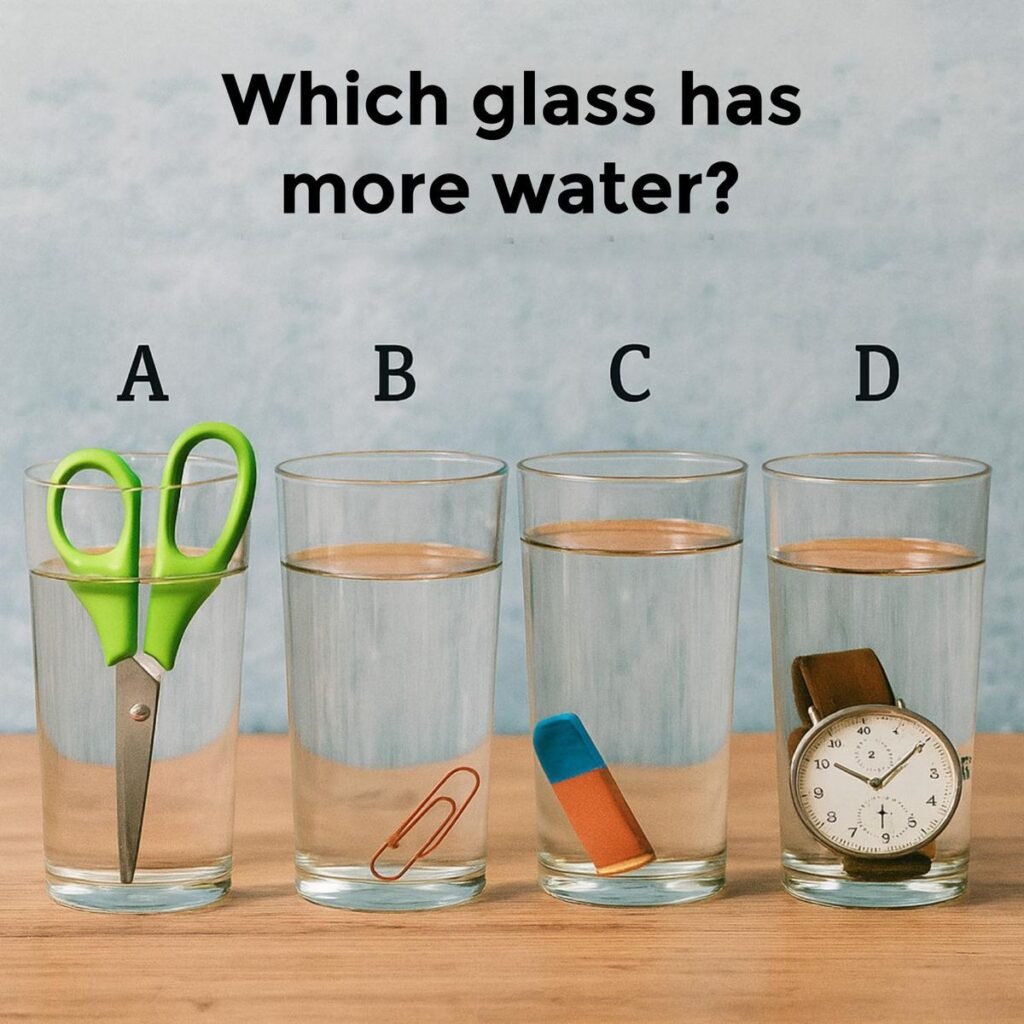
- Glass A (Scissors): Substantial size and metallic/plastic mass, displacing a large volume of water.
- Glass D (Wristwatch): Heavy casing, face, and leather strap, occupying a very large physical volume.
- Glass C (Eraser): Solid rectangular block taking up moderate space.
- Glass B (Paperclip): Extremely thin wire construction occupying the smallest physical volume of all four objects.
Since the total visual level in all glasses is equal:
$$\text{Actual Water Volume} = \text{Total Water Level} – \text{Object Volume}$$
Because the paperclip in Glass B takes up the least space, the least amount of water was displaced to reach that line. Consequently, removing the paperclip leaves behind the highest volume of actual liquid!
Object Volume & Water Ranking Table
| Glass | Submerged Item | Object Volume / Space Occupied | Actual Water Volume | Ranking (Most to Least Water) |
| B | Paperclip | Smallest (Minimal Displacement) | Highest | 1st (Most Water) |
| C | Eraser | Moderate | Medium-High | 2nd |
| A | Scissors | Large | Medium-Low | 3rd |
| D | Wristwatch | Largest (Maximum Displacement) | Lowest | 4th (Least Water) |
Conclusion
The correct answer is Glass B. Because the paperclip occupies the smallest physical volume of any item shown, Glass B contains the most actual water.
Frequently Asked Questions (FAQ)
Why is Glass B the correct answer?
All glasses show roughly the same total liquid line. Since the paperclip in Glass B takes up the smallest volume, less water is displaced by the object, meaning Glass B contains the most actual water.
What scientific law explains this puzzle?
This puzzle demonstrates Archimedes’ Principle of displacement, which states that any object submerged in a fluid displaces a volume of fluid equal to its own volume.