

What Did You See First? The Science Behind Visual Perception & Pareidolia
Visual optical illusions offer a fascinating glimpse into how human visual processing works. When we look at a scene, our brain instantly organizes patterns, shapes, and lighting into recognizable structures—sometimes creating vivid secondary images that aren’t actually there!
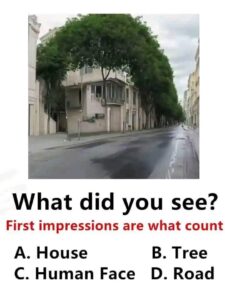
A popular viral visual test asks a simple question about a street scene photo:
“What did you see? First impressions are what count”
The image presents four primary options:
-
A. House: The pale residential buildings along the sidewalk.
-
B. Tree: The full, leafy green trees overhanging the street.
-
C. Human Face: A side-profile human face formed by the negative space and contours of the scene.
-
D. Road: The asphalt street running through the center of the image.
Below, we break down how this optical illusion works and explore why different people spot different elements first!
How the Illusion Works: The Hidden Human Profile
At first glance, the photo appears to be a standard city street. However, the composition creates an optical illusion of a large human face in profile looking toward the left:
-
The Hair & Forehead: The dense, dark green tree canopy forms the hair and upper forehead of the face.
-
The Nose & Lips: The balcony structure and architectural lines of the house in the center align perfectly to form the nose, mouth, and chin profile.
-
The Eye: The shaded window/balcony area under the tree leaves acts as an eye socket.
-
The Neck & Shoulder: The curb and street line extend downward to form the neck and jawline.
Perception Breakdown: What Your First Impression Means
| Choice | Visual Focus | Brain Processing Pattern |
| A. House / B. Tree / D. Road | Literal Observation | Focuses on individual object recognition, detail orientation, and direct environmental context. |
| C. Human Face | Gestalt / Global Processing | Focuses on the whole picture instantly, triggering pareidolia (face recognition) through visual patterns. |
The Science of Seeing Faces (Pareidolia)
Why do so many viewers spot option C (Human Face) immediately?
1. Hardwired Face Recognition
Humans possess a specialized area of the brain called the Fusiform Face Area (FFA). Because identifying human facial expressions was critical to human survival and social bonding throughout evolution, our brains are hardwired to recognize facial structures instantly—even in non-living surroundings like trees, clouds, or architecture.
2. Gestalt Principles of Perception
Our visual system naturally attempts to unify disparate visual elements into a single coherent shape. The alignment of the tree leaves, house angles, and street layout tricks the brain into completing the outline of a face.
Conclusion
Whether you saw a tranquil urban street or a giant hidden profile, this visual puzzle highlights the incredible speed and adaptability of human perception. Every brain interprets visual input uniquely!
Frequently Asked Questions (FAQ)
What is pareidolia?
Pareidolia is a psychological phenomenon where the mind perceives a familiar or meaningful pattern—such as a human face—where no actual human feature exists.
Why do some people see the literal scene before the face?
Visual processing styles vary. Some individuals process details from the ground up (local processing), noticing specific objects like houses or trees first, while others process the entire image at once (global processing), catching the overall shape or face immediately.