


The Classic 6 Eggs Riddle Solved: How Many Are Really Left?
Riddles that play on word order and sequential actions are among the most viral brain teasers on social media. They test whether readers are paying attention to the relationship between actions or simply treating every sentence as a separate math problem.
A classic egg counting riddle poses a seemingly simple scenario:
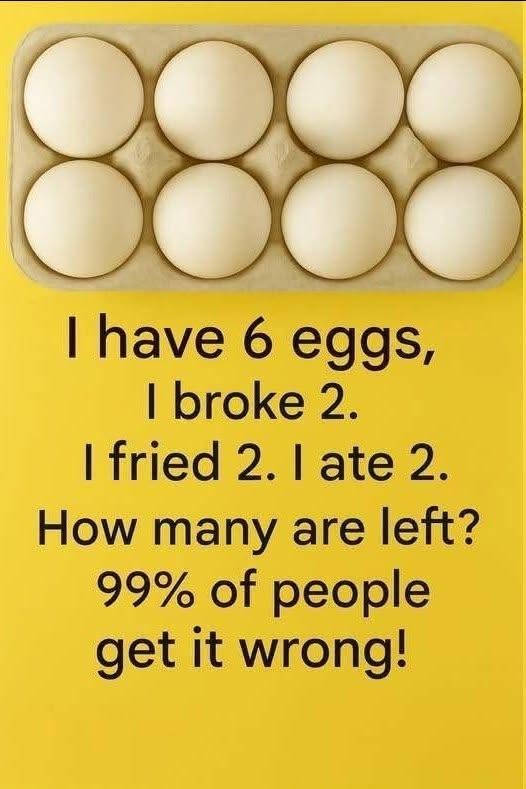
“I have 6 eggs. I broke 2. I fried 2. I ate 2. How many are left? 99% of people get it wrong!”
At first glance, many people subtract every number mentioned ($6 – 2 – 2 – 2 = 0$) and guess zero. However, analyzing the natural sequence of cooking reveals the real answer!
Below, we break down the logic step-by-step.
Step-by-Step Logic Breakdown
To solve this riddle, you have to look at how someone actually prepares and eats eggs:
-
You Start with 6 Eggs: You have a carton/batch containing 6 eggs.
-
You Broke 2 Eggs: In order to cook eggs, you must crack them open first. So you break 2 eggs.
-
You Fried 2 Eggs: You don’t break 2 other eggs—you fry the same 2 eggs that you just broke!
-
You Ate 2 Eggs: Naturally, you eat the same 2 eggs that you broke and fried!
The Final Calculation:
-
Total starting eggs: 6
-
Eggs processed (broken, fried, eaten): 2
-
Eggs remaining untouched: $6 – 2 = 4$
There are 4 eggs left in the carton!
Why People Get This Riddle Wrong
This visual word puzzle creates confusion through two main cognitive traps:
-
Assuming Cumulative Subtraction: Readers tend to treat “broke 2,” “fried 2,” and “ate 2” as three separate sets of 2 eggs ($2 + 2 + 2 = 6$), assuming all 6 were used.
-
Ignoring Contextual Chronology: In real life, breaking, frying, and eating are sequential steps performed on the exact same pair of eggs.
Breakdown Matrix
| Action | Action Applied To | Eggs Remaining Intact / Untouched |
| Start | 6 total eggs | 6 |
| Broke 2 | The 1st set of 2 eggs | 4 |
| Fried 2 | The same set of 2 broken eggs | 4 |
| Ate 2 | The same set of 2 cooked eggs | 4 |
Alternative Interpretations (The Wordplay Variations)
While 4 is the universally accepted correct answer to the riddle, literal interpretations sometimes spark fun debates in the comment section:
-
If all actions were separate: If you broke 2 eggs (ruined/discarded), fried 2 different eggs, and ate 2 other eggs, then $6 – 2 – 2 – 2 = 0$ eggs left.
-
If “left” refers to cooked/eaten vs intact: You still have 4 raw eggs in the carton, plus 2 eggs inside your stomach!
Conclusion
Unless you’re breaking eggs without frying them and eating raw ones separately, the 2 eggs you broke are the 2 eggs you fried, which are the 2 eggs you ate. That leaves 4 whole eggs untouched!
Frequently Asked Questions (FAQ)
What is the official answer to the 6 eggs riddle?
The official and intended answer is 4. The riddle describes the sequential process of preparing and eating two eggs out of a set of six.
Why does the riddle say “99% of people get it wrong”?
Social media riddles use hyperbole like “99% fail” to encourage engagement, prompt readers to re-read carefully, and spur lively debate in comment sections!