

Personality Test: Which Chair Would You Sit In? The Meeting Room Test Revealed
Visual personality tests, seating choice quizzes, and situational psychological teasers are immensely popular across social media platforms. How you instinctively react when entering a room—especially a conference room or formal meeting setting—can say a lot about your subconscious priorities, social confidence, authority awareness, and communication style.
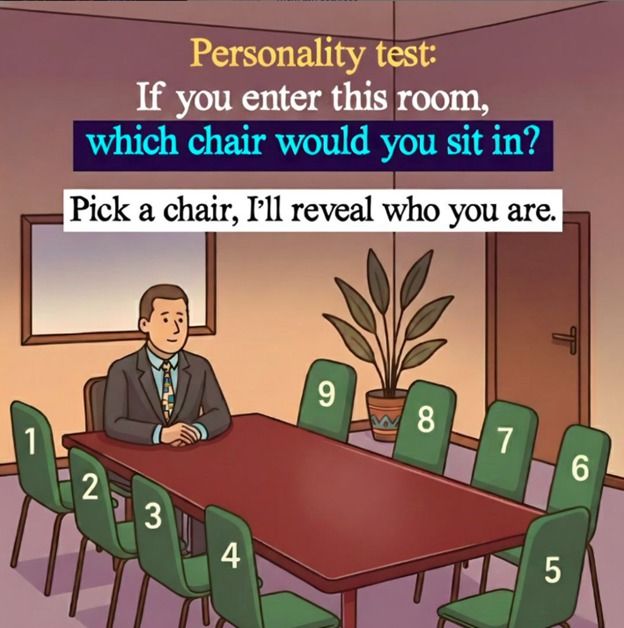
The viral seating challenge titled “Personality test: If you enter this room, which chair would you sit in?” places you in a common scenario: entering a meeting room where one person is already seated at the head of the table. Surrounding the large conference table are nine numbered green chairs (1 through 9).
Your choice of chair reflects your subconscious interpersonal strategy. In this guide, we break down what each chair choice reveals about your personality, explore the psychology of spatial behavior (proxemics), and share practical tips for navigating room dynamics in real life.
Deconstructing the Seating Map: What Your Chair Choice Means
Here is the psychological personality breakdown for each chair number chosen upon entering the room.
Chair 1: The Direct Authority Challenger / Co-Leader
-
Position: Directly adjacent to the seated person on their right.
-
Personality Insights: Choosing Chair 1 shows high confidence, assertiveness, and comfort with authority. You are not intimidated by leaders or key decision-makers. You like to be right in the action and prefer direct, transparent communication.
Chairs 2 & 3: The Supportive Ally & Collaborative Communicator
-
Position: Along the left side of the table, close to the host/leader.
-
Personality Insights: Sitting in Chairs 2 or 3 suggests a balanced, highly cooperative personality. You value teamwork and active participation without needing to steal the spotlight. You are a dependable collaborator who likes being near key conversations.
Chair 4: The Pragmatic Observer
-
Position: Far left side, near the foot of the table.
-
Personality Insights: Choosing Chair 4 shows practical intelligence and strategic observation. You prefer to analyze the whole room, observe people’s reactions, and gather all facts before speaking up.
Chair 5: The Direct Confrontational / Primary Counterpart
-
Position: Head of the table directly opposite the seated person.
-
Personality Insights: Chair 5 represents the direct eye-contact power seat. Sitting here indicates a strong, independent personality who views themselves as an equal. You are willing to lead debates, present big ideas, or hold direct one-on-one discussions without backing down.
Chair 6: The Boundary Guardian
-
Position: Far right corner, near the door and the foot of the table.
-
Personality Insights: Choosing Chair 6 reflects a desire for autonomy, psychological safety, and clear exit paths. You prioritize personal space and like to keep your options open. You are thoughtful, self-reliant, and protective of your personal boundaries.
Chairs 7 & 8: The Balanced Mediator & Diplomat
-
Position: Along the right side of the table, middle position.
-
Personality Insights: Sitting in Chairs 7 or 8 suggests a warm, diplomatic personality. You prefer a comfortable distance where you can see everyone clearly without feeling put on the spot. You excel at keeping discussions balanced and smooth.
Chair 9: The Right-Hand Advisor
-
Position: Directly adjacent to the seated person on their left (near the plant).
-
Personality Insights: Sitting in Chair 9 shows strong emotional intelligence and supportive leadership. You are comfortable offering quiet counsel, advisory input, and strategic backing to leaders without needing public praise.
The Visual Breakdown Summary
| Chair Choice | Strategic Role | Key Personality Traits |
| Chair 1 | Direct Co-Leader | High confidence, bold, comfortable with authority |
| Chairs 2 & 3 | Collaborative Teammate | Dependable, team-oriented, active listener |
| Chair 4 | Strategic Observer | Analytical, practical, facts-first approach |
| Chair 5 | Direct Counterpart | Strong-willed, equal partner, assertive communicator |
| Chair 6 | Autonomous Guardian | Independent, boundary-focused, values flexibility |
| Chairs 7 & 8 | Diplomatic Mediator | Balanced, empathetic, great at group harmony |
| Chair 9 | Trusted Advisor | Insightful, supportive, low-ego leadership |
The Psychology of Proxemics: How Spatial Distance Shapes Perception
The study of how humans use space during communication is known in psychology as proxemics (pioneered by anthropologist Edward T. Hall). How you select a seat in a room is rarely random; it is driven by non-verbal psychological factors:
1. Spatial Power Dynamics
-
Side-by-Side (Chairs 1 & 9): Signals cooperation, partnership, and shared focus on a common goal.
-
Face-to-Face (Chair 5): Signals direct engagement, negotiation, potential debate, or direct evaluation.
-
Diagonal or Side Positions (Chairs 2, 3, 7, 8): Promotes comfortable, low-stress conversation without direct visual confrontation.
2. Environmental Safety and Eye Contact
People who value security often gravitate toward seats near the wall or door (such as Chair 6), where they have a complete view of the room’s entry points. People with high social tolerance and extraversion feel comfortable sitting right at the center of attention.
Practical Tips for Real-Life Business & Social Meetings
Understanding seating psychology can help you influence meeting outcomes and communicate effectively:
-
To Build Rapport Quickly: Sit at a 90-degree angle relative to the primary speaker (such as Chair 2 or 8) to keep conversation relaxed and cooperative.
-
To Lead or Negotiate: Take the center seat facing the primary speaker (Chair 5) to establish equal footing and project confidence.
-
To Listen and Synthesize: Choose mid-table seats where you can maintain eye contact with all participants without forcing direct eye contact with a single person.
Conclusion
Whether you choose Chair 1 to sit right next to the leader or Chair 5 to look them directly in the eye, your choice reflects your unique social style and communication approach.
Taking a fun situational personality test like this is a great way to reflect on your interpersonal preferences and understand how spatial dynamics shape your daily interactions!
Frequently Asked Questions (FAQ)
What does sitting in Chair 5 mean?
Sitting in Chair 5 means you are confident, direct, and view yourself as an equal counterpart to the person already seated at the head of the table.
What is the most popular chair choice in meeting room tests?
Chairs 2, 3, and 7 are among the most frequently chosen because they offer a comfortable balance between active participation and personal personal space.
What is proxemics in personality psychology?
Proxemics is the study of how people use personal space and visual distance to communicate status, comfort, power, and intimacy in social settings.