 Skip to content

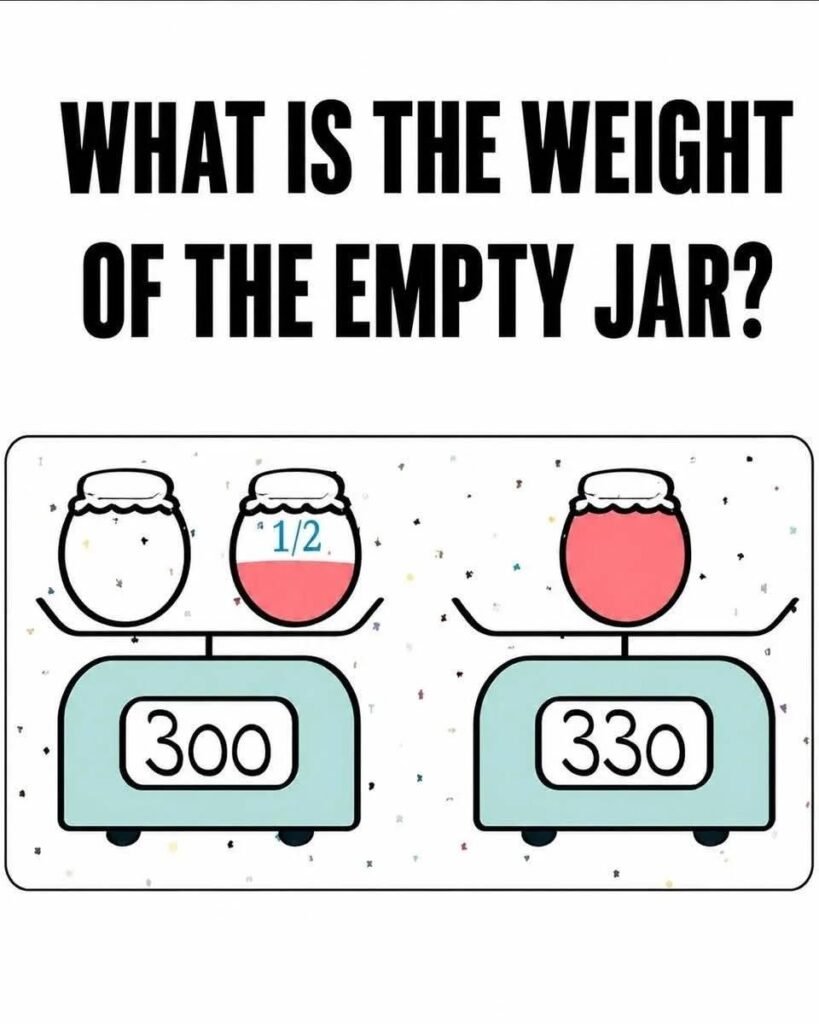

Simple visual math puzzles are a viral favorite across social media because they look deceptively easy at first glance. However, solving them requires setting up basic algebraic equations and separating the weight of the container from its contents.
In this math puzzle, we are given two scale readings involving glass jars filled with liquid or jam:
-
Left Scale: One empty jar + one half-full jar = 300
-
Right Scale: One completely full jar = 330
Below, we break down the step-by-step mathematical proof to find the exact weight of an empty jar.
Step-by-Step Math Solution
To solve the puzzle, let:
-
$J = \text{weight of one empty jar}$
-
$F = \text{weight of the full liquid/contents in one jar}$
Step 1: Write out the equations based on the image
From the right scale:
From the left scale:
Step 2: Express $F$ in terms of $J$
From the first equation ($J + F = 330$), isolate $F$:
Step 3: Substitute $F$ into the second equation
Substitute $(330 – J)$ in place of $F$ in the left scale’s equation:
Expand the equation:
Step 4: Solve for $J$ (Weight of the Empty Jar)
Subtract 165 from both sides:
Divide both sides by 1.5:
Double Checking the Results
Let’s verify our math to make sure everything adds up correctly:
-
Weight of an Empty Jar ($J$): 90
-
Weight of Full Contents ($F$): $330 – 90 =$ 240
-
Weight of Half Contents ($\frac{1}{2}F$): $\frac{240}{2} =$ 120
Now check both scales:
-
Right Scale (Full Jar): Jar (90) + Full Contents (240) = 330 (Matches!)
-
Left Scale (Empty Jar + Half-Full Jar): Jar (90) + [Jar (90) + Half Contents (120)] = 90 + 210 = 300 (Matches!)
The weight of the empty jar is 90.
Why Math Puzzles Are Great for Problem-Solving Skills
Visual algebra riddles are an excellent way to keep your mind sharp:
1. Translates Visuals to Logic
Working through visual equations forces the brain to translate qualitative pictures into quantitative variables ($J$ and $F$).
2. Prevents Common Cognitive Traps
Many people make fast, incorrect assumptions—like assuming the contents weigh 300 or 330 directly—without factoring in that the glass jar itself carries weight on both scales!
Conclusion
Did you calculate 90 as the weight of the empty jar? Sharing math brain teasers like this is a great way to challenge your friends and exercise your logical reasoning skills!
Frequently Asked Questions (FAQ)
What is the correct answer to the empty jar puzzle?
The correct weight of the empty jar is 90.
How much do the contents inside the jar weigh when completely full?
The liquid or jam inside a full jar weighs 240 units.
What is the easiest shortcut to solve this puzzle?
Notice that going from the right scale (1 full jar = 330) to the left scale (1 empty jar + 1 half jar) adds an extra empty jar body ($+J$) but removes half the liquid ($-\frac{1}{2}F$). Since $F = 330 – J$, you can quickly substitute and solve for $J$ in under a minute!