

IQ Test Circle Puzzle: What Is the Missing Number? Solution Explained
Math riddles, sequence challenges, and IQ test puzzles generate incredible engagement across social media platforms like Facebook. By testing pattern recognition, algebraic thinking, and basic mental arithmetic, these brain teasers invite readers to test their problem-solving skills against a visual puzzle.
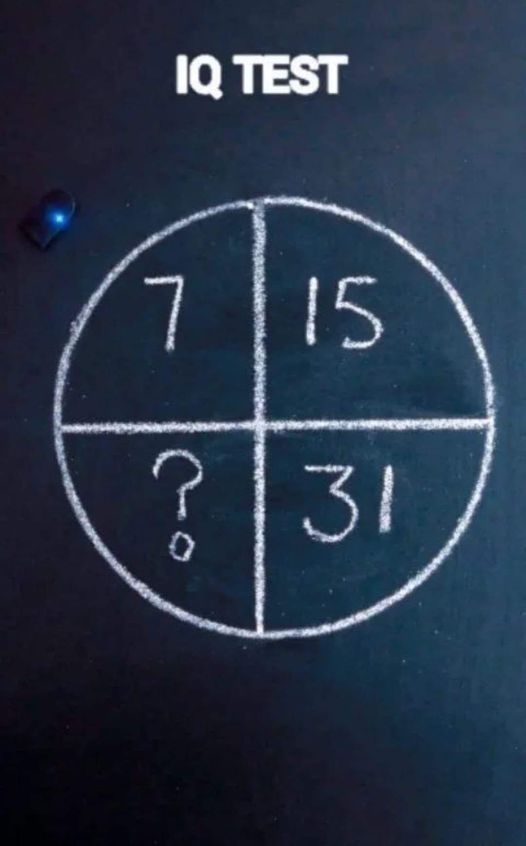
A popular math puzzle shows a circle divided into four quadrants with the numbers:
7, 15, 31, and “?”
At first glance, the numbers seem somewhat random, but tracing them in sequence reveals a clear arithmetic rule. In fact, depending on how you view the progression, there are two mathematically sound ways to solve it—with 63 being the most widely recognized primary answer.
In this guide, we break down the step-by-step mathematical logic behind the circle puzzle, derive the formulas, and explain both potential solutions.
Detailed Mathematical Breakdown
To find the missing number, we analyze the progression of numbers clockwise around the circle, starting from the top-left quadrant:
                         [ NUMBER PATTERN SEQUENCE ]
                                      |
      -----------------------------------------------------------------
     |                                |                                |
 [ STEP 1: 7 TO 15 ]          [ STEP 2: 15 TO 31 ]         [ STEP 3: 31 TO ? ]
 • 7 * 2 + 1 = 15             • 15 * 2 + 1 = 31            • 31 * 2 + 1 = 63
 • Difference = +8            • Difference = +16           • Difference = +32
Method 1: The Multiplicative Pattern $(2x + 1)$
-
First Transition (Top-Left to Top-Right):
Start with $7$. Multiply by $2$ and add $1$:
$$7 \times 2 + 1 = 14 + 1 = 15$$ -
Second Transition (Top-Right to Bottom-Right):
Take $15$. Apply the same formula:
$$15 \times 2 + 1 = 30 + 1 = 31$$ -
Third Transition (Bottom-Right to Bottom-Left):
Take $31$. Apply the same formula to solve for the missing question mark:
$$31 \times 2 + 1 = 62 + 1 = \mathbf{63}$$
Method 2: Powers of Two $(2^n – 1)$
Another elegant way to view this sequence is through powers of two:
-
Top-Left (7): $2^3 – 1 = 8 – 1 = 7$
-
Top-Right (15): $2^4 – 1 = 16 – 1 = 15$
-
Bottom-Right (31): $2^5 – 1 = 32 – 1 = 31$
-
Bottom-Left (?): $2^6 – 1 = 64 – 1 = \mathbf{63}$
Summary of Sequence Methods
| Quadrant Location | Given / Derived Value | Formula (2x+1) | Power of 2 Formula (2n−1) |
| Top-Left | 7 | Starting Number | $2^3 – 1 = 7$ |
| Top-Right | 15 | $(7 \times 2) + 1 = 15$ | $2^4 – 1 = 15$ |
| Bottom-Right | 31 | $(15 \times 2) + 1 = 31$ | $2^5 – 1 = 31$ |
| Bottom-Left | 63 | $(31 \times 2) + 1 = \mathbf{63}$ | $2^6 – 1 = \mathbf{63}$ |
(Note: If the loop completes continuously back to 7, setting $(? \times 2) + 1 = 7$ yields $?=3$, making 3 a clever alternative answer for loop completion!)
Conclusion
The primary solution to the missing number puzzle is 63. Whether you use the recursive formula $f(n) = 2n + 1$, double the difference added at each step ($+8, +16, +32$), or evaluate powers of two minus one, all major mathematical methods converge on 63.
Frequently Asked Questions (FAQ)
What is the formula to solve this IQ test puzzle?
The primary formula is $f(x) = 2x + 1$, where each number in the sequence is multiplied by 2 and increased by 1 to yield the next number clockwise.
Is 3 also a valid answer for this puzzle?
Yes! If you treat the circle as a continuous closed loop where the missing number is the starting point before 7, then $(3 \times 2) + 1 = 7$, making 3 a secondary logical solution.