
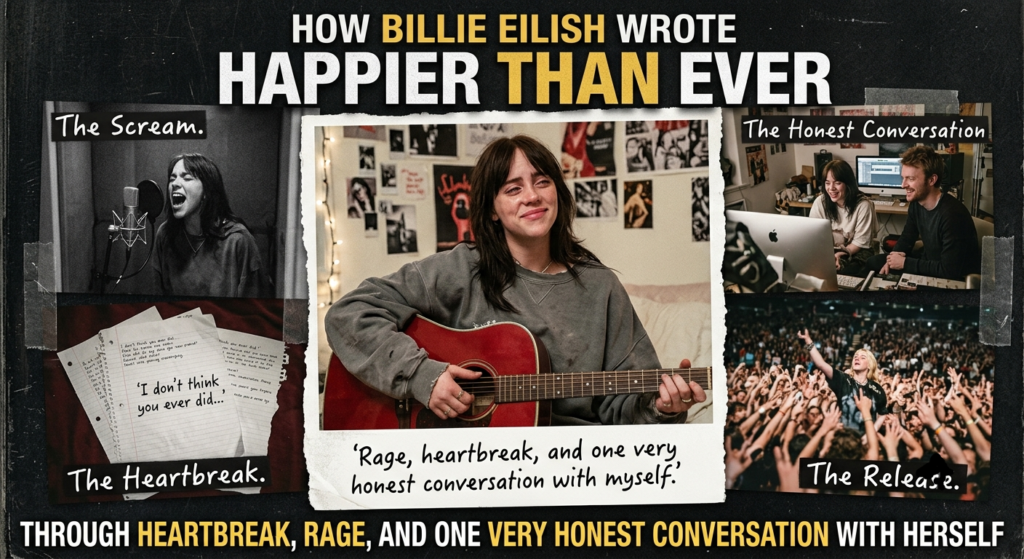
There is a moment in every great artist’s life when they stop performing for the world and start performing for themselves. For Billie Eilish that moment came somewhere between the impossible pressure of being the most talked about young musician on the planet, the suffocating weight of public scrutiny on her body and her relationships and her every public move, and the quiet devastating experience of a heartbreak that she had not yet found the words to properly describe. Out of all of that the pressure and the pain and the very specific kind of loneliness that comes from being simultaneously everywhere and completely misunderstood came “Happier Than Ever.” Released in July 2021, the album is widely considered the artistic turning point of Billie Eilish’s career. Critics called it a masterpiece. Fans called it the album that felt like Billie finally saying everything she had always wanted to say. Rolling Stone placed it among the best albums of the year. It debuted at number one in multiple countries simultaneously. But the story of how it actually came to exist the real behind the scenes human story of what Billie and Finneas went through to make it — is far more fascinating and far more moving than any chart position could ever communicate.
The Weight of Being Billie Eilish
To understand what “Happier Than Ever” meant for Billie you first have to understand what the years leading up to it had actually felt like from the inside. By 2019 Billie Eilish was not just famous. She was a cultural phenomenon in the specific overwhelming way that only happens to a handful of artists in any given generation. The green hair. The oversized clothes. The aesthetic that was entirely her own. The voice that could whisper and still fill an arena. She was everywhere simultaneously and the world felt like it had very strong opinions about every single aspect of her existence. When she appeared on the cover of British Vogue in 2021 wearing a corset and form fitting clothing that was dramatically different from her signature baggy style, the internet essentially lost its collective mind. Everyone had something to say. Everyone felt entitled to an opinion about her body, her choices, her identity, her supposed hypocrisy. Billie addressed this moment directly and with extraordinary clarity in multiple interviews. She talked about the impossible double standard she faced criticized for hiding her body, then criticized for showing it. Criticized for being too young, then criticized for growing up. Criticized for being too sad, then criticized for being happy. “I felt like I was not allowed to be a person,” she told British Vogue in that now legendary interview. “Like whatever I did was wrong.” That feeling of being trapped between other people’s contradictory expectations of who she was supposed to be became the emotional foundation of “Happier Than Ever.”
A Bedroom, a Heartbreak, and Complete Honesty
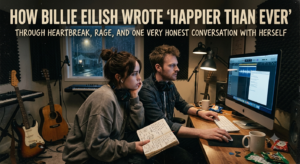
The recording process for “Happier Than Ever” happened largely during the COVID-19 pandemic lockdown period a strange and disorienting time that turned out to be unexpectedly creatively liberating for Billie and Finneas. Without the constant noise of touring schedules and public appearances and the relentless machinery of fame temporarily removed from the equation, the two siblings found themselves in a rare and precious creative space. They had time. They had quiet. And Billie had things she needed to say. She has spoken in interviews about going through a significant heartbreak during this period a painful relationship experience that she channeled directly into the songwriting process with a rawness and specificity that her earlier work, brilliant as it was, had not always allowed. The title track “Happier Than Ever” tells this story with almost uncomfortable directness. The song begins as a quiet acoustic piece gentle, almost fragile and then erupts in its second half into something completely different. A release of pure unfiltered rage and grief that Billie delivers with a vocal performance of staggering emotional power. In interviews Billie described the song’s explosive second half as something that surprised even her when it emerged. “It just kind of happened,” she told Apple Music’s Zane Lowe in one of her most revealing interviews of that period. “I was just feeling it and Finneas was right there and we just let it go where it wanted to go.” That creative instinct to follow the emotion wherever it honestly leads rather than shaping it into something more comfortable or more commercially predictable is what makes “Happier Than Ever” the album it is.
Finneas and the Brother Who Always Knows
No telling of this story is complete without talking about Finneas O’Connell because the making of “Happier Than Ever” was as much his story as it was Billie’s. The brother and sister creative partnership that began in that Highland Park bedroom when Billie was thirteen had by this point become one of the most celebrated and analyzed creative collaborations in contemporary music. But what the Grammy statistics and the critical acclaim sometimes obscures is how genuinely personal and emotionally intimate that collaboration actually is.
Finneas has described the process of making “Happier Than Ever” as one of the most emotionally intense creative experiences of his life. He was not just producing tracks and arranging sounds. He was sitting with his little sister while she processed some of the most painful and complicated experiences of her young life and he was helping her translate all of that into music.
There is a particular moment documented in the Apple TV documentary “Billie Eilish: The World’s a Little Blurry” which was released in February 2021 and gave audiences an extraordinary window into her life and creative process where the dynamic between the two siblings is captured with breathtaking authenticity. The ease. The shorthand. The way they push each other creatively while simultaneously protecting each other emotionally. “He knows when something is right,” Billie has said about Finneas in multiple
We want to hear from you: Which song on “Happier Than Ever” hit you the hardest the first time you heard it and why? Share your story in the comments below because this album belongs to every single person who has ever felt misunderstood and found their way through it! 🎵💚