 Skip to content


Honeycomb Pattern Puzzle Solution: Finding the Missing Piece
Visual pattern and spatial reasoning puzzles are fantastic for sharpening mental acuity and boosting engagement across social media platforms. By challenging readers to mentally rotate and fit complex geometric shapes into a grid, these riddles encourage deliberate observation and problem-solving.
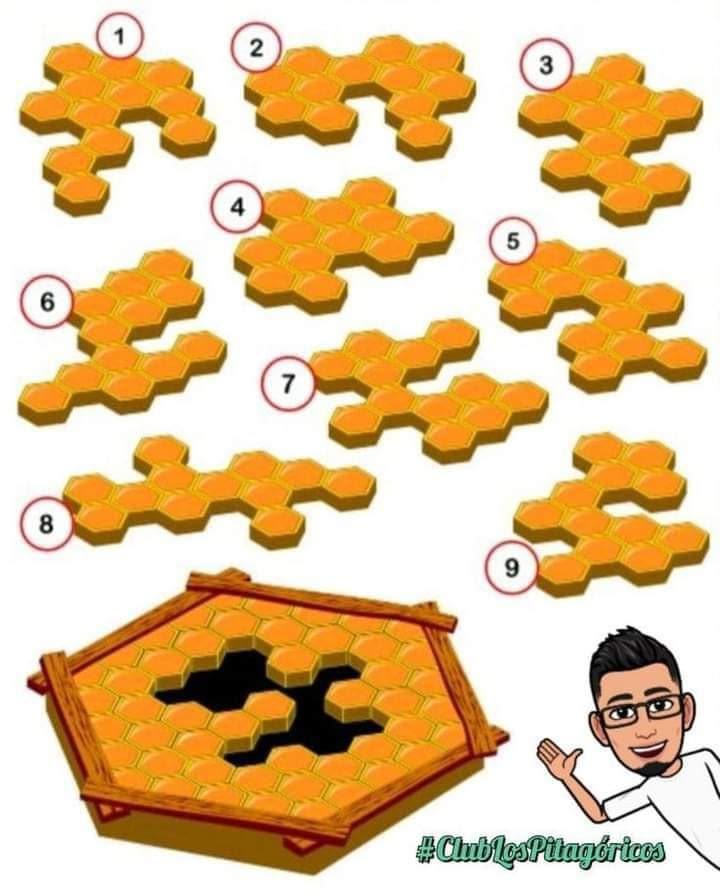
A viral visual puzzle presents a framed hexagonal honeycomb board with a missing section in the center, alongside nine numbered candidate pieces:
“Find the piece that fits the gap (1–9).”
While several pieces share similar honeycomb textures and bright golden colors, only Piece 7 possesses the exact silhouette and notch alignment required to fill the gap perfectly without overlapping or leaving empty spaces.
In this guide, we break down the key visual clues, analyze why other options fall short, and explain the step-by-step logic behind the solution.
Step-by-Step Solution Breakdown
To determine the correct piece, examine the distinct border features of the black gap in the honeycomb frame:
                          [ GAP BOUNDARY MATCHING ]
                                     |
      ---------------------------------------------------------------
     |                               |                               |
 [ TOP-CENTER NOTCH ]      [ BOTTOM-CENTER NOTCH ]     [ SIDE EXTENSIONS ]
 • A single yellow cell    • A yellow cell points      • Left arm extends down
   points DOWN into gap      UP into the gap             • Right arm fills lower-right
Key Identifying Features:
-
The Top-Center Indentation: At the top edge of the black opening, a single golden honeycomb cell points downward into the gap. The matching piece must have a single-cell notch at its top center.
-
The Bottom-Center Indentation: Along the lower edge of the opening, another golden cell points upward into the gap, requiring a corresponding notch at the bottom center.
-
Left & Right Arms: The gap extends outward to the left (a 2-cell diagonal tail) and opens into a wider block on the right side.
Option Comparison & Elimination Table
| Piece # | Top-Center Notch | Bottom-Center Notch | Overall Fit Status |
| 1 | ❌ None (Flat top) | ❌ Incorrect shape | Incorrect |
| 2 | ❌ Gap too wide (2 cells) | ❌ Missing bottom extensions | Incorrect |
| 3 | ❌ None (Convex top) | ❌ Incorrect contour | Incorrect |
| 4 | ❌ None (Flat top) | ❌ Missing left tail | Incorrect |
| 5 | ❌ None | ❌ S-curve alignment | Incorrect |
| 6 | ❌ Incorrect left placement | ❌ Missing right section | Incorrect |
| 7 | ✅ Exact single-cell notch | ✅ Exact bottom notch | PERFECT MATCH |
| 8 | ❌ Offset notch | ❌ Elongated shape | Incorrect |
| 9 | ❌ None | ❌ Compact grid | Incorrect |
How to Solve Grid Matching Puzzles Quickly
-
Focus on Negative Space: Instead of looking at the overall shape, focus on “anchor points”—the sharpest corners or single protruding cells in the gap.
-
Count the Key Clusters: Count how many cells wide each section of the gap is (e.g., 2 cells on the top-left, 2 cells on the top-right).
-
Eliminate Mismatches First: Rapidly discard any piece that lacks a critical notch or feature, narrowing your choices down to 1 or 2 options.
Conclusion
By matching the top-center downward cell and the bottom-center upward cell with the corresponding notches, Piece 7 is the only candidate that completes the honeycomb structure perfectly!
Frequently Asked Questions (FAQ)
Why do candidate pieces 2 and 7 look so similar?
Piece 2 has a top opening that is two cells wide, whereas the board’s gap only has a single protruding cell pointing down. Piece 7 accounts for this exact single-cell width.
What cognitive skills do grid puzzles train?
These puzzles train spatial visualization, mental rotation, and visual discrimination—key components of non-verbal IQ tests.