 Skip to content

Can You Find the Mistake? The Classic Brain Teaser Explained
Visual reading traps, proofreading puzzles, and attention-to-detail teasers are among the most effective engagement formats across social networks. Designed to test focus and reading comprehension, these posts play tricks on how our brains process written language.
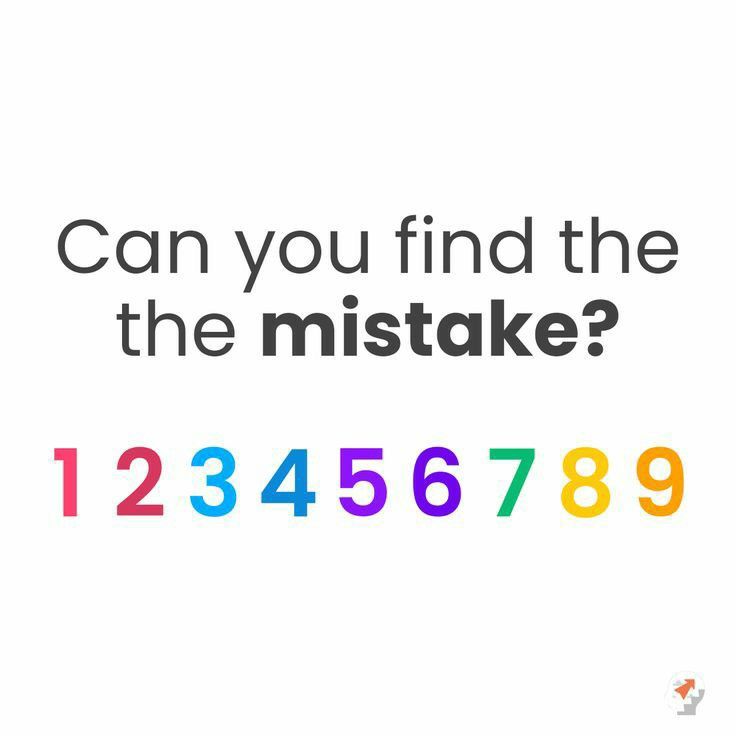
One classic viral graphic poses a simple challenge:
“Can you find the mistake?”
1 2 3 4 5 6 7 8 9
At first glance, most readers immediately scan the row of colorful numbers looking for a missing digit, an out-of-order sequence, or a mathematical anomaly. However, the numbers from 1 through 9 are completely correct!
In this guide, we reveal the actual mistake, explain the psychological science behind why your brain skips right over it, and break down why this trick works so well online.
Deconstructing the Image: Spotting the Trick
To find the error in this puzzle, you have to look away from the numbers and read the question line by line very carefully.
                  [ "Can you find the the mistake?" ]
                                  |
            ----------------------------------------------
           |                                              |
 [ THE QUESTION TEXT ]                          [ THE NUMBER LINE ]
 • "Can you find the the mistake?"              • 1 2 3 4 5 6 7 8 9
 • Notice the repeated word: "the the"          • Sequentially perfect
 • RESULT: This is the real mistake!            • RESULT: A distraction!
1. The Typo in the Text
The word “the” is written twice in a row at the top of the image:
“Can you find the the mistake?”
2. The Number Misdirection
The sequence 1 2 3 4 5 6 7 8 9 is perfectly ordered and brightly colored. The colors and large numbers are intentionally designed to act as a visual distraction, drawing your focus away from the text where the real error is hiding.
Why Your Brain Skips the Double Word
Why is it so difficult to spot repeated words like “the the” on a first pass?
| Cognitive Mechanism | How It Works | Impact on the Puzzle |
| Typoglycemia / Automatic Reading | The brain reads whole phrases rather than individual letters once fluency is developed. | Your brain automatically filters out the second “the” to smooth out sentence comprehension. |
| Visual Priming | Brightly colored numbers grab immediate visual attention over monochrome text. | Forces the brain to assume the mistake must be in the number sequence. |
| Expectation Bias | Puzzles formatted with numbers make us expect a mathematical or sequence error. | Focuses cognitive effort on counting rather than proofreading. |
Practical Tips for Proofreading and Solving Text Puzzles
-
Read Out Loud or Backwards: Reading text aloud word-by-word (or reading a sentence backward) breaks automatic language processing, making repeated words stand out immediately.
-
Beware of Visual Distractions: When a graphic presents bright, bold elements alongside small plain text, check the plain text first!
Conclusion
The mistake in the puzzle isn’t in the numbers at all—it’s the repeated word “the” in the headline: “Can you find the the mistake?”
Taking a quick moment to test your attention with proofreading challenges is a fun way to train your brain to slow down and notice the small details!
Frequently Asked Questions (FAQ)
What is the mistake in “Can you find the mistake?”
The word “the” is repeated twice in the top sentence: “Can you find the the mistake?”
Are the numbers 1 through 9 wrong?
No, the number sequence from 1 to 9 is in perfect numerical order and contains no errors.
Why do most people miss the duplicate word?
Because of cognitive fluency—the human brain automatically filters out unnecessary repetitive words to make reading faster and more efficient.