 Skip to content

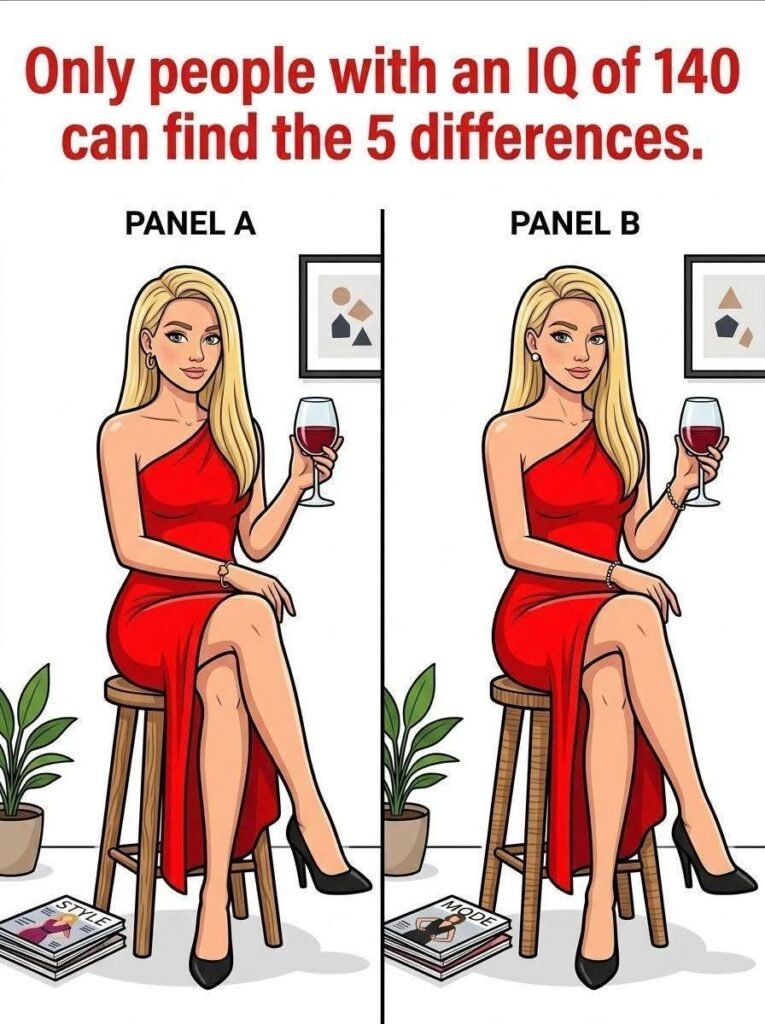

Visual puzzles and “spot the difference” games are among the most engaging brain teasers on social media. They test your attention to detail, visual pattern recognition, and spatial processing skills in a fun, quick challenge.
Social media posts often feature intriguing headlines claiming that “only people with an IQ of 140 can find the 5 differences.” While these captions are designed to spark friendly competition and curiosity, solving visual puzzles is simply a matter of careful observation and patience!
Below, we break down all 5 subtle differences between Panel A and Panel B in this visual puzzle, explore why your brain loves visual challenges, and share tips for spotting hidden details faster.
The 5 Differences Revealed (Panel A vs. Panel B)
If you were searching for every hidden detail, here is the complete answer key:
1. The Earring Shape
-
Panel A: The woman is wearing a hoop earring.
-
Panel B: The earring is a round stud/pearl.
2. The Wrist Bracelets
-
Panel A: She wears a single golden chain bracelet on her resting right wrist (left in frame).
-
Panel B: She wears silver/beaded bracelets on both wrists.
3. The Wall Artwork Shapes
-
Panel A: The picture frame behind her displays a circle and a rectangle/square composition.
-
Panel B: The artwork inside the frame features a distinct triangle shape.
4. The Magazine Title & Cover Design
-
Panel A: The magazine stack on the floor reads “STYLE” with a red dress on the cover.
-
Panel B: The magazine title changes to “MODE” with a black dress on the cover.
5. The Stool Legs / Wood Texture
-
Panel A: The wooden stool legs are smooth with clean vertical wood grain.
-
Panel B: The stool legs feature pronounced horizontal ridge textures/ring carvings.
Addressing Viral Puzzle Claims vs. Brain Science
Setting realistic expectations around IQ and online puzzles helps keep brain training fun and accurate:
-
The Myth: Failing to spot all 5 differences means you have a low IQ, while finding them instantly proves high intelligence.
-
The Reality: Visual puzzles test selective attention, working memory, and visual search strategies rather than overall intellectual quotient (IQ). Factors like screen brightness, image resolution, fatigue, and viewing angle play a massive role in how quickly your eyes scan for contrast and anomalies.
4 Pro Tips for Solving Visual Puzzles Faster
Want to sharpen your observation skills for future puzzles? Try these visual scanning techniques:
1. Divide and Scan Grid by Grid
Instead of looking at the image as a whole, mentally divide the frame into four quadrants (top-left, top-right, bottom-left, bottom-right) and compare corresponding sections systematically.
2. Cross Your Eyes (3D Cross-Eye Technique)
Focus on the line between the two panels and gently cross your eyes until the two images merge in the center. Any differences will appear to “flicker” or glow softly because your brain receives conflicting visual input!
3. Compare Background Elements First
Creators often hide subtle differences in background objects (like picture frames, plants, furniture textures, or floor items) because viewers naturally focus on the central subject first.
4. Look for Color Swaps and Text Changes
Always check logos, magazine titles, clothing colors, and accessories—these are classic spots for puzzle creators to tweak fine details.
Fascinating Facts About Visual Perception
-
Selective Attention: Your brain filters out up to 90% of visual information coming through the optic nerve to avoid sensory overload, focusing primarily on motion and sharp color contrast.
-
Brain Exercise: Regularly solving visual puzzles stimulates neural pathways in the parietal lobe, the region of the brain responsible for visual-spatial reasoning and processing sensory input.
Conclusion
Spotting all 5 differences is a great way to give your brain a quick mental workout during the day. Whether you found all 5 instantly or needed a quick hint, keeping your mind active with visual challenges is both fun and rewarding!
Frequently Asked Questions (FAQ)
What is the best strategy for solving spot-the-difference puzzles?
Scanning systematically from top to bottom or using the cross-eye stereogram technique are the two fastest ways to identify subtle variations between two near-identical images.
Do spot-the-difference puzzles improve cognitive health?
Yes! Engaging in daily visual search tasks, crosswords, and logic puzzles helps maintain mental agility, focus, and short-term visual memory across all ages.