 Skip to content


Knowledge vs. Application: Why Information Without Action Is Ineffective
In the modern digital era, access to information is unlimited. However, having access to resources, tools, or knowledge does not automatically translate to success or problem-solving. Real-world impact requires practical understanding—knowing how and when to apply what we have learned.
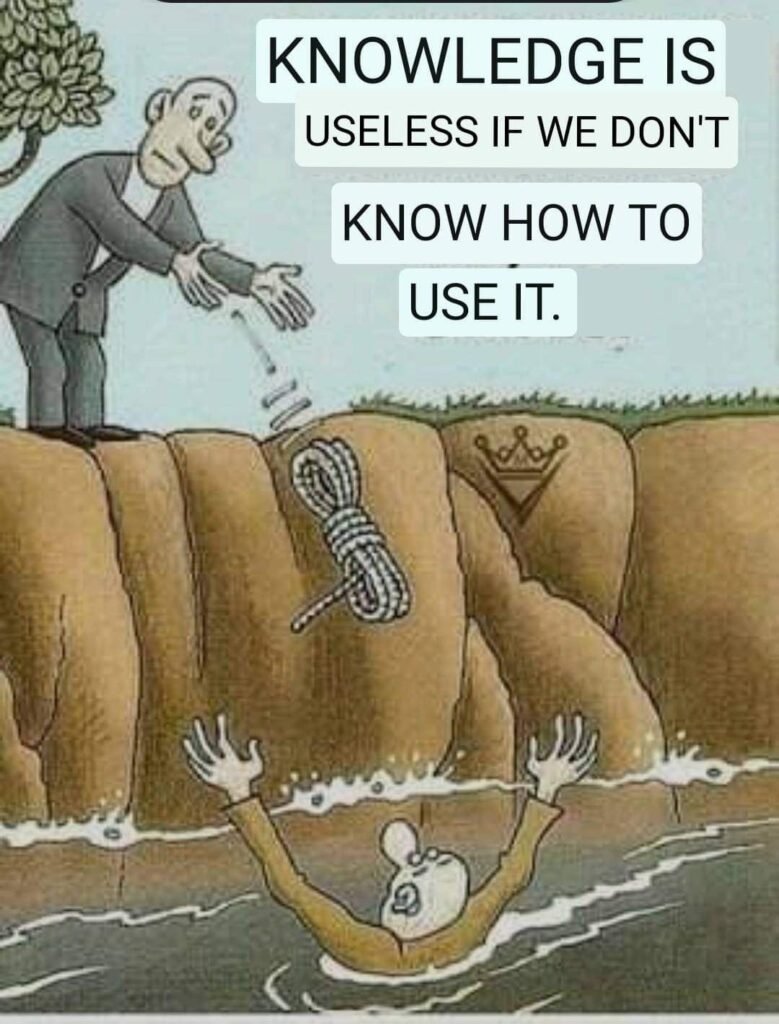
A thought-provoking conceptual illustration vividly captures this gap:
“KNOWLEDGE IS USELESS IF WE DON’T KNOW HOW TO USE IT.”
The image depicts a man drowning in rough waters, reaching up for assistance. On the cliff above, another man attempts to help by throwing a heavy, neatly bound coil of rope down into the water. However, because the rope is thrown all at once without keeping hold of an end or uncoiling it, the rescue attempt fails entirely despite having the exact tool needed for the job.
Below, we explore the core message behind this visual and examine how to bridge the gap between theory and execution!
The Danger of Theoretical Knowledge Without Practice
The artwork highlights a frequent pitfall in learning, business, and personal development: confusing possession of a tool with the skill to use it.
1. Having the Tool vs. Knowing the Technique
The man on the cliff possesses a rescue rope—the exact solution required for a drowning person. However, throwing the entire coiled bundle renders the tool useless. In life, collecting degrees, certificates, or tools without mastering execution yields no practical benefit.
2. Good Intentions Without Strategic Action
Having positive intentions or theoretical understanding isn’t enough when execution is flawed. Misapplying knowledge in high-stakes situations can lead to wasted effort and missed opportunities.
Breakdown Matrix: Theory vs. Practical Mastery
| Dimension | Possession / Theory (The Coiled Rope) | Execution / Mastery (Uncoiling & Anchoring) |
| Focus | Accumulating tools, info, and concepts | Applying tools to solve specific problems |
| Real-World Value | Potential value only | Immediate, tangible impact |
| Mindset | “I know what tool to use.” | “I know how to execute the solution.” |
| Common Outcome | Frustration despite effort | Successful problem resolution |
3 Strategies to Turn Knowledge into Effective Action
1. Shift from Passive Learning to Active Practice
Don’t just collect information or read guides. Apply new concepts immediately through small, real-world projects or scenario testing to build practical muscle memory.
2. Master the Basics of Execution
Before attempting complex tasks, ensure you understand the foundational mechanics—just as a rescuer must know to anchor one end of a rope before throwing it.
3. Seek Feedback and Refine Your Technique
When an attempt fails despite having the right tools, analyze the process rather than blaming the tool. Identify where execution broke down and adjust your approach.
Conclusion
The illustration serves as a powerful reminder that knowledge is only potential power. True mastery comes from knowing how to uncoil our knowledge, hold fast to our goals, and apply solutions effectively when they matter most!
Frequently Asked Questions (FAQ)
What is the difference between data, knowledge, and wisdom?
Data consists of raw facts. Knowledge is understanding those facts in context. Wisdom is knowing how and when to apply that knowledge effectively in real-world scenarios.
How can teams improve their execution skills?
Teams can improve execution by breaking down complex processes into actionable steps, conducting regular simulations or practice runs, and focusing on clear role responsibility during critical tasks